Buy خح.com ?
We are moving the project
خح.com .
Are you interested in purchasing the domain
خح.com ?
domain@kv-gmbh.de · 0541-91531010
Buy خح.com ?
How many words does the Arabic language have?
The Arabic language has an estimated 12.3 million words. This number includes both standard Arabic words and dialectal variations. Arabic is known for its rich vocabulary and diverse linguistic heritage, with words derived from various sources such as classical Arabic, Quranic Arabic, and loanwords from other languages. **
Why does the Arabic language have so many words?
The Arabic language has a large vocabulary due to its rich history and diverse influences. Over the centuries, Arabic has absorbed words from various languages, including Aramaic, Persian, Greek, and Turkish, as well as from the cultures it has come into contact with through trade and conquest. Additionally, Arabic has a complex system of word formation, allowing for the creation of new words through the addition of prefixes, suffixes, and internal modifications. This has contributed to the language's extensive lexicon, making it one of the most diverse and expressive languages in the world. **

Similar search terms for Words
Top-Angebote
Products related to Words:
-
Uplift Treasures Positive Words Colorful Beaded Bracelet Set Positive Words Colorful Beaded Bracelet SetProduct Description: Brighten any outfit with this fun 12 piece beaded bracelet set featuring colorful candy inspired beads and uplifting word details. Perfect for stacking, sharing, or gifting, these cheerful bracelets add a playful touch to...52,97 $*Shipping: 0,00 $Secure redirect to the provider
-
Certified International Halloween Words MugsSomewhere between pouring the first October cup of coffee and surviving the post-trick-or-treat sugar crash, there is a mug that understands exactly what you are going through — and says so with the precision and honesty of a very good dictionary...32,44 $*Shipping: 0,00 $Secure redirect to the provider
-
DK French for Everyone Junior 5 Words a Day: Learn and Practise 1,000 French WordsHelp your child master French vocabulary - five words at a time!Learn 1000 French words over a year with this French workbook for beginners! It's an essential vocabulary builder for young children who are starting to learn their first French words.Discover the perfect introduction to French for children aged 6-9. It's the ultimate French lesson for kids! It includes:- Beautifully illustrated scenes that teach and test five words at a time. New vocabulary is practised again at the end of each week in two pages of exercises- Clever flaps on the jacket that cover the scene so your child can practise what they have just learned- Uses the effective rote-learning method to teach new vocabulary- Teaches a range of nouns and verbs that are useful in everyday life; audio is available online and via a handy app to help with pronunciationThis unique French teaching guide contains everything your child needs to acquire a firm grasp of the French language in a fun and interactive way! Each week, 20 new words are presented over four days, and on the fifth day, your child can practise the words they have just learned. This will help them build up a vocabulary of more than 1000 French words over the course of a year!From animals and sports to colours and plants, French for Everyone Junior teaches a mix of nouns and verbs through stunning illustrations with each new word clearly labelled. This encourages young learners to memorise the words before covering them with the cleverly designed flaps and testing their new knowledge. Accompanying audio means that children can also practice their French pronunciation as many times as they want.The colourful, clear and comprehensive 5 Words a Day series from DK lays the foundations for your child's journey in learning a foreign language, at school or home. Look out for other workbooks in the series! Help your child learn, practise, and understand 1000 German words in German for Everyone Junior: 5 Words a Day.7,99 £*Shipping: 2,99 £Secure redirect to the provider
-
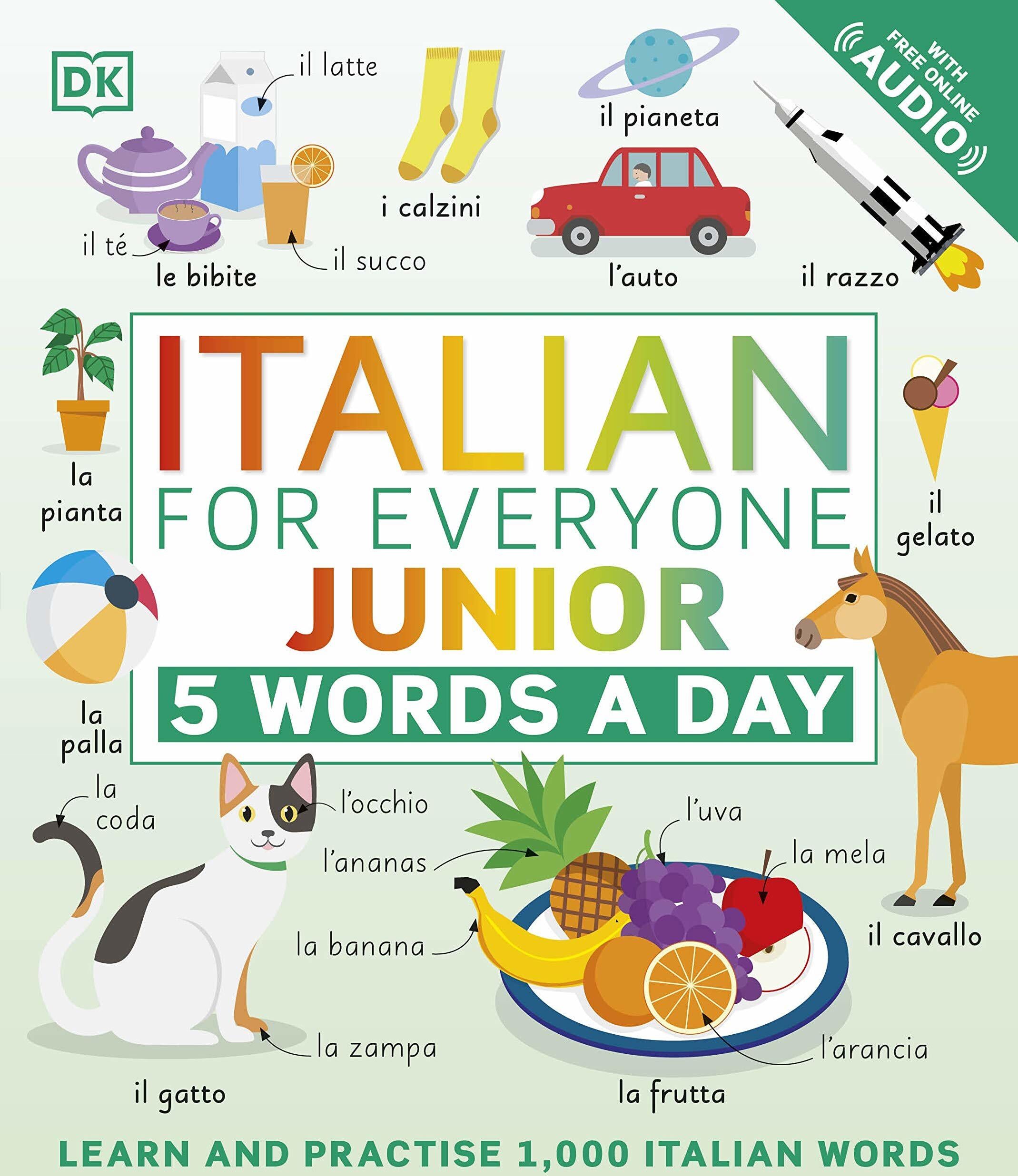
DK Italian for Everyone Junior 5 Words a Day: Learn and Practise 1,000 Italian WordsHelp your child master Italian vocabulary - five words at a time! Learn 1000 Italian words over a year with this Italian workbook for beginners! It's an essential vocabulary builder for young children who are starting to learn their first Italian words. Discover the perfect introduction to Italian for children aged 6-9. It's the ultimate Italian lesson book for kids! It includes: - Beautifully illustrated scenes that teach and test five words at a time. New vocabulary is practised again at the end of each week in two pages of exercises - Clever flaps on the jacket that cover the scene so your child can practise what they have just learned - Uses the effective rote-learning method to teach new vocabulary - Teaches a range of nouns and verbs that are useful in everyday life; audio is available online and via a handy app to help with pronunciation Learning a foreign language is one of the best ways to develop your child's cognitive and language abilities. What's more, children gain insight into other cultures and their linguistic nuances. This language book covers Italian vocabulary, Italian pronunciation and makes learning the first Italian words easy and fun. Illustrations, exciting scenes, and audio recordings allow your child to immerse themselves in their Italian language-learning journey fully! Italian Everyone Junior 5 Words a Day encourages children to copy the nouns and verbs related to each scene in the book, to test their knowledge by covering the words with jacket flaps, and learn one new Italian word every day.7,95 £*Shipping: 2,99 £Secure redirect to the provider


-
Why are numbers written in words in the Arabic language?
Numbers are written in words in the Arabic language to maintain the purity and beauty of the Arabic script. Writing numbers in words also helps to avoid confusion with similar-looking letters in the Arabic alphabet. Additionally, it is a traditional practice that has been preserved over time, and it is considered more formal and aesthetically pleasing in written Arabic. Finally, writing numbers in words can also help to reinforce the learning and understanding of the Arabic language and its script. **
-
What do these Arabic words mean?
The Arabic words "Salam" and "Shukran" mean "peace" and "thank you" respectively. "Salam" is used as a greeting and also conveys the wish for peace and well-being. "Shukran" is used to express gratitude and appreciation. Both words are commonly used in Arabic-speaking countries as part of everyday interactions. **
-
What are the basic words in Arabic?
The basic words in Arabic are typically nouns, verbs, and prepositions. Nouns are used to name people, places, and things, while verbs are used to describe actions or states of being. Prepositions are used to show the relationship between different elements in a sentence. These basic words form the foundation of the Arabic language and are essential for constructing sentences and expressing ideas. **
-
Why do German teenagers use Arabic words?
German teenagers use Arabic words for a variety of reasons. One reason is the influence of popular culture, including music and social media, which often incorporates Arabic words and phrases. Additionally, Germany has a significant population of Arabic speakers, and the use of Arabic words may be a way for teenagers to connect with and show respect for this community. Finally, using Arabic words can also be a form of rebellion or a way to stand out and express individuality within their peer group. **

How are numbers expressed in Arabic words?
Numbers in Arabic are expressed using a combination of words and numerals. For example, the number 25 is expressed as "خمسة وعشرون" (khamsa wa-‘ishrun), which translates to "five and twenty." Larger numbers are also expressed in a similar way, with the tens and ones place being stated separately. For example, the number 345 is expressed as "ثلاثمائة وخمسة وأربعون" (thalaathamia wa-khamsa wa-arba'oun), which translates to "three hundred and five and forty." **
Which German words have an Arabic origin?
Some German words with Arabic origins include "Zucker" (sugar), "Zitrone" (lemon), "Alkohol" (alcohol), "Giraffe" (giraffe), and "Kaffee" (coffee). These words were borrowed from Arabic during the Middle Ages when trade and cultural exchange between the Arab world and Europe were flourishing. The influence of Arabic on the German language is a testament to the historical connections between the two regions. **
Top-Angebote
Products related to Words:
-
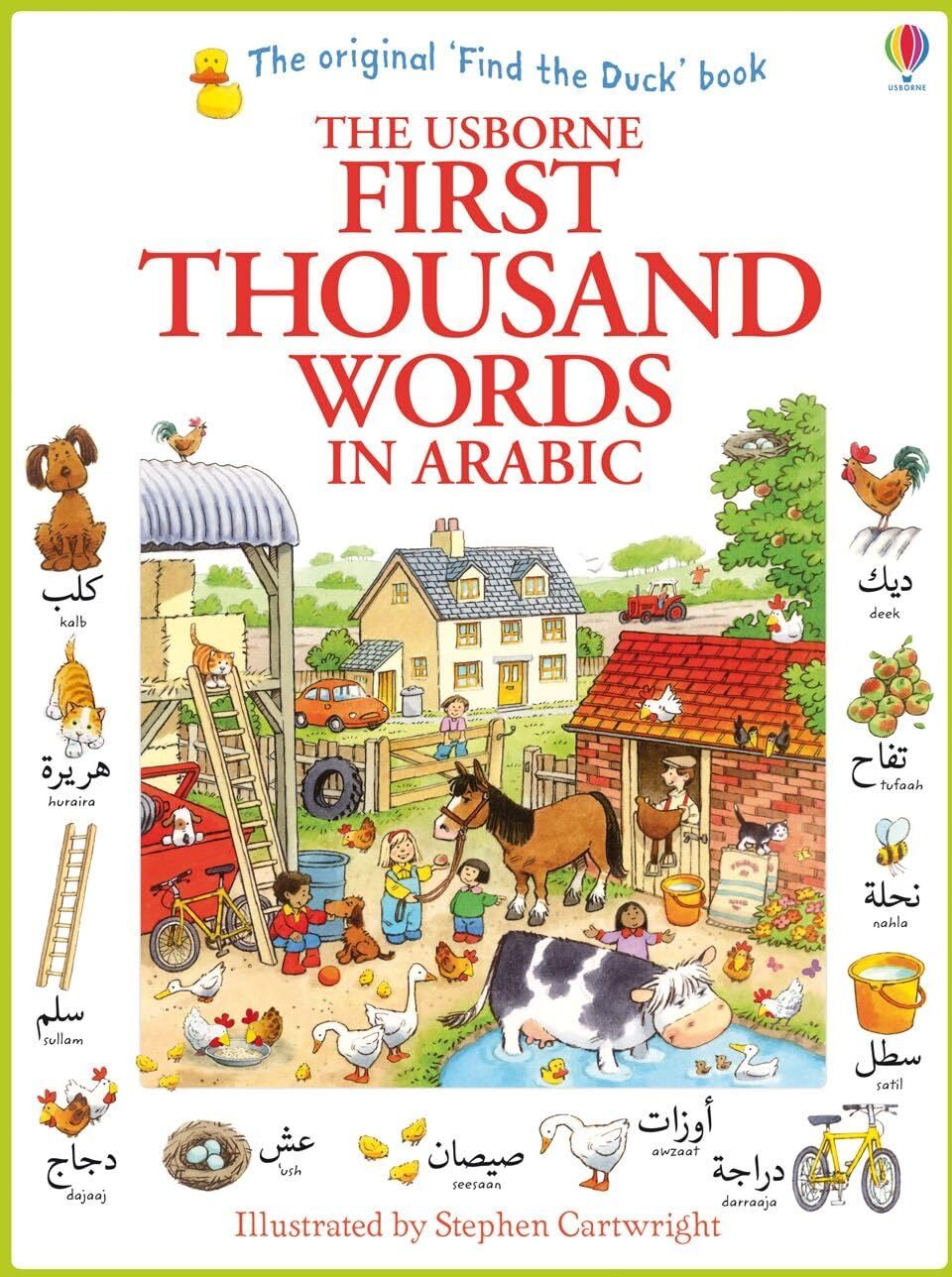
Usborne My First Thousand Words In Arabic Book NewUsborne My First Thousand Words in Arabic Book NEW Description: This highly effective picture word book contain a thousand everyday Arabic words in lively scenes. Stephan Cartwright's delightful pictures encourage direct association of the word with the object; a proven aid to a long-term learning. What's more; readers can hear how to pronounce all the Arabic words in this book by listening to a native speaker on the Usborne Quicklinks website. The Usborne First Thousand Words in Arabic is an ideal and enjoyable way for learners of all ages to build their knowledge of this language. Related Tags: Usborne, Usbourne4,49 £*Shipping: 1,99 £Secure redirect to the provider
-
Usborne Publishing Ltd First Thousand Words in Arabic by Heather Amery - Usborne Bilingual Arabic-English Word Book - Paperback - Ages 5-7 - 1000 Words with PicturesFirst Thousand Words in Arabic is a bilingual word book that introduces young Arabic learners and English-speaking families to everyday words. The book features a thousand words set inside busy, brightly coloured scenes, with labelled objects in both Arabic script and English. A simple pronunciation guide supports the learning process, making it an ideal first step into bilingual reading for children, homeschoolers, and classrooms. Written by Heather Amery and illustrated by Stephen Cartwright, this book belongs to Usborne's popular First Thousand Words series, which has introduced millions of children worldwide to new languages through pictures rather than lists. The book is organised thematically, guiding readers through a range of topics and objects.2,99 £*Shipping: 2,99 £Secure redirect to the provider
-
Uplift Treasures Positive Words Colorful Beaded Bracelet Set Positive Words Colorful Beaded Bracelet SetProduct Description: Brighten any outfit with this fun 12 piece beaded bracelet set featuring colorful candy inspired beads and uplifting word details. Perfect for stacking, sharing, or gifting, these cheerful bracelets add a playful touch to...52,97 $*Shipping: 0,00 $Secure redirect to the provider
-
Certified International Halloween Words MugsSomewhere between pouring the first October cup of coffee and surviving the post-trick-or-treat sugar crash, there is a mug that understands exactly what you are going through — and says so with the precision and honesty of a very good dictionary...32,44 $*Shipping: 0,00 $Secure redirect to the provider
-
How many words does the Arabic language have?
The Arabic language has an estimated 12.3 million words. This number includes both standard Arabic words and dialectal variations. Arabic is known for its rich vocabulary and diverse linguistic heritage, with words derived from various sources such as classical Arabic, Quranic Arabic, and loanwords from other languages. **
-
Why does the Arabic language have so many words?
The Arabic language has a large vocabulary due to its rich history and diverse influences. Over the centuries, Arabic has absorbed words from various languages, including Aramaic, Persian, Greek, and Turkish, as well as from the cultures it has come into contact with through trade and conquest. Additionally, Arabic has a complex system of word formation, allowing for the creation of new words through the addition of prefixes, suffixes, and internal modifications. This has contributed to the language's extensive lexicon, making it one of the most diverse and expressive languages in the world. **
-
Why are numbers written in words in the Arabic language?
Numbers are written in words in the Arabic language to maintain the purity and beauty of the Arabic script. Writing numbers in words also helps to avoid confusion with similar-looking letters in the Arabic alphabet. Additionally, it is a traditional practice that has been preserved over time, and it is considered more formal and aesthetically pleasing in written Arabic. Finally, writing numbers in words can also help to reinforce the learning and understanding of the Arabic language and its script. **
-
What do these Arabic words mean?
The Arabic words "Salam" and "Shukran" mean "peace" and "thank you" respectively. "Salam" is used as a greeting and also conveys the wish for peace and well-being. "Shukran" is used to express gratitude and appreciation. Both words are commonly used in Arabic-speaking countries as part of everyday interactions. **
Similar search terms for Words
-
DK French for Everyone Junior 5 Words a Day: Learn and Practise 1,000 French WordsHelp your child master French vocabulary - five words at a time!Learn 1000 French words over a year with this French workbook for beginners! It's an essential vocabulary builder for young children who are starting to learn their first French words.Discover the perfect introduction to French for children aged 6-9. It's the ultimate French lesson for kids! It includes:- Beautifully illustrated scenes that teach and test five words at a time. New vocabulary is practised again at the end of each week in two pages of exercises- Clever flaps on the jacket that cover the scene so your child can practise what they have just learned- Uses the effective rote-learning method to teach new vocabulary- Teaches a range of nouns and verbs that are useful in everyday life; audio is available online and via a handy app to help with pronunciationThis unique French teaching guide contains everything your child needs to acquire a firm grasp of the French language in a fun and interactive way! Each week, 20 new words are presented over four days, and on the fifth day, your child can practise the words they have just learned. This will help them build up a vocabulary of more than 1000 French words over the course of a year!From animals and sports to colours and plants, French for Everyone Junior teaches a mix of nouns and verbs through stunning illustrations with each new word clearly labelled. This encourages young learners to memorise the words before covering them with the cleverly designed flaps and testing their new knowledge. Accompanying audio means that children can also practice their French pronunciation as many times as they want.The colourful, clear and comprehensive 5 Words a Day series from DK lays the foundations for your child's journey in learning a foreign language, at school or home. Look out for other workbooks in the series! Help your child learn, practise, and understand 1000 German words in German for Everyone Junior: 5 Words a Day.7,99 £*Shipping: 2,99 £Secure redirect to the provider
-
DK Italian for Everyone Junior 5 Words a Day: Learn and Practise 1,000 Italian WordsHelp your child master Italian vocabulary - five words at a time! Learn 1000 Italian words over a year with this Italian workbook for beginners! It's an essential vocabulary builder for young children who are starting to learn their first Italian words. Discover the perfect introduction to Italian for children aged 6-9. It's the ultimate Italian lesson book for kids! It includes: - Beautifully illustrated scenes that teach and test five words at a time. New vocabulary is practised again at the end of each week in two pages of exercises - Clever flaps on the jacket that cover the scene so your child can practise what they have just learned - Uses the effective rote-learning method to teach new vocabulary - Teaches a range of nouns and verbs that are useful in everyday life; audio is available online and via a handy app to help with pronunciation Learning a foreign language is one of the best ways to develop your child's cognitive and language abilities. What's more, children gain insight into other cultures and their linguistic nuances. This language book covers Italian vocabulary, Italian pronunciation and makes learning the first Italian words easy and fun. Illustrations, exciting scenes, and audio recordings allow your child to immerse themselves in their Italian language-learning journey fully! Italian Everyone Junior 5 Words a Day encourages children to copy the nouns and verbs related to each scene in the book, to test their knowledge by covering the words with jacket flaps, and learn one new Italian word every day.7,95 £*Shipping: 2,99 £Secure redirect to the provider
-
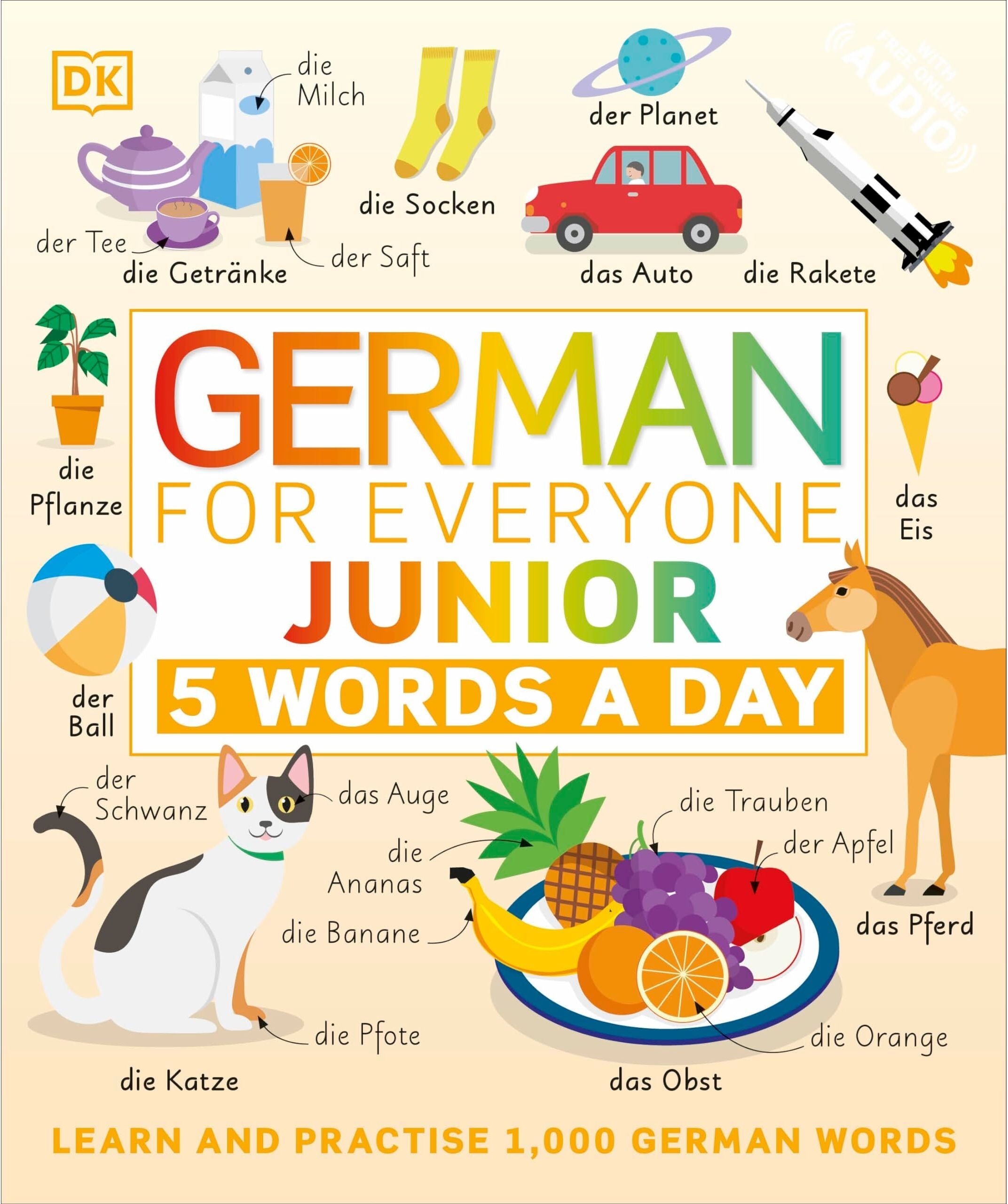
DK German for Everyone Junior 5 Words a Day: Learn and Practise 1,000 German WordsHelp your child master German vocabulary - five words at a time! Learn 1000 German words over a year with this German workbook for beginners! It's an essential vocabulary builder for young children who are starting to learn their first German words. Discover the perfect introduction to German for children aged 6-9. It's the ultimate German lesson for kids! It includes: - Beautifully illustrated scenes that teach and test five words at a time. New vocabulary is practised again at the end of each week in two pages of exercises - Clever flaps on the jacket that cover the scene so your child can practise what they have just learned - Uses the effective rote-learning method to teach new vocabulary - Teaches a range of nouns and verbs that are useful in everyday life; audio is available online and via a handy app to help with pronunciation This unique German teaching guide contains everything your child needs to acquire a firm grasp of the German language in a fun and interactive way! Each week, 20 new words are presented over four days, and on the fifth day, your child can practise the words they have just learned. This will help them build up a vocabulary of more than 1000 German words over the course of a year! From animals and sports to colours and plants, German for Everyone Junior teaches a mix of nouns and verbs through stunning illustrations with each new word clearly labelled. This encourages young learners to memorise the words before covering them with the cleverly designed flaps and testing their new knowledge. Accompanying audio means that children can also practice their German pronunciation as many times as they want.7,95 £*Shipping: 2,99 £Secure redirect to the provider
-
Wipe Clean Words Activity Pack 4 Books Collection Set with Pen by Sandcastle Books - Phonics, Tricky Words, Word Fun & First Words - Ages 3-5 - PaperbackGive your child a head start with the Wipe Clean Words Activity Pack, a four-book collection designed to build early reading confidence through repeatable, mess-free practice. Covering Phonics, Tricky Words, Word Fun, and First Words, each book comes with a wipe-clean pen so children can write, wipe away, and try again as many times as they like, making learning to read and write feel like play rather than pressure. This engaging four-book set has been carefully put together to support children as they take their very first steps into reading and writing. Each title in the collection focuses on a different core literacy skill. Phonics introduces letter sounds and blending in a fun, visual way, helping children decode simple words with confidence. Tricky Words tackles those common high-frequency words.6,99 £*Shipping: 2,99 £Secure redirect to the provider
-
What are the basic words in Arabic?
The basic words in Arabic are typically nouns, verbs, and prepositions. Nouns are used to name people, places, and things, while verbs are used to describe actions or states of being. Prepositions are used to show the relationship between different elements in a sentence. These basic words form the foundation of the Arabic language and are essential for constructing sentences and expressing ideas. **
-
Why do German teenagers use Arabic words?
German teenagers use Arabic words for a variety of reasons. One reason is the influence of popular culture, including music and social media, which often incorporates Arabic words and phrases. Additionally, Germany has a significant population of Arabic speakers, and the use of Arabic words may be a way for teenagers to connect with and show respect for this community. Finally, using Arabic words can also be a form of rebellion or a way to stand out and express individuality within their peer group. **
-
How are numbers expressed in Arabic words?
Numbers in Arabic are expressed using a combination of words and numerals. For example, the number 25 is expressed as "خمسة وعشرون" (khamsa wa-‘ishrun), which translates to "five and twenty." Larger numbers are also expressed in a similar way, with the tens and ones place being stated separately. For example, the number 345 is expressed as "ثلاثمائة وخمسة وأربعون" (thalaathamia wa-khamsa wa-arba'oun), which translates to "three hundred and five and forty." **
-
Which German words have an Arabic origin?
Some German words with Arabic origins include "Zucker" (sugar), "Zitrone" (lemon), "Alkohol" (alcohol), "Giraffe" (giraffe), and "Kaffee" (coffee). These words were borrowed from Arabic during the Middle Ages when trade and cultural exchange between the Arab world and Europe were flourishing. The influence of Arabic on the German language is a testament to the historical connections between the two regions. **
* All prices are inclusive of VAT and, if applicable, plus shipping costs. The offer information is based on the details provided by the respective shop and is updated through automated processes. Real-time updates do not occur, so deviations can occur in individual cases. ** Note: Parts of this content were created by AI.